
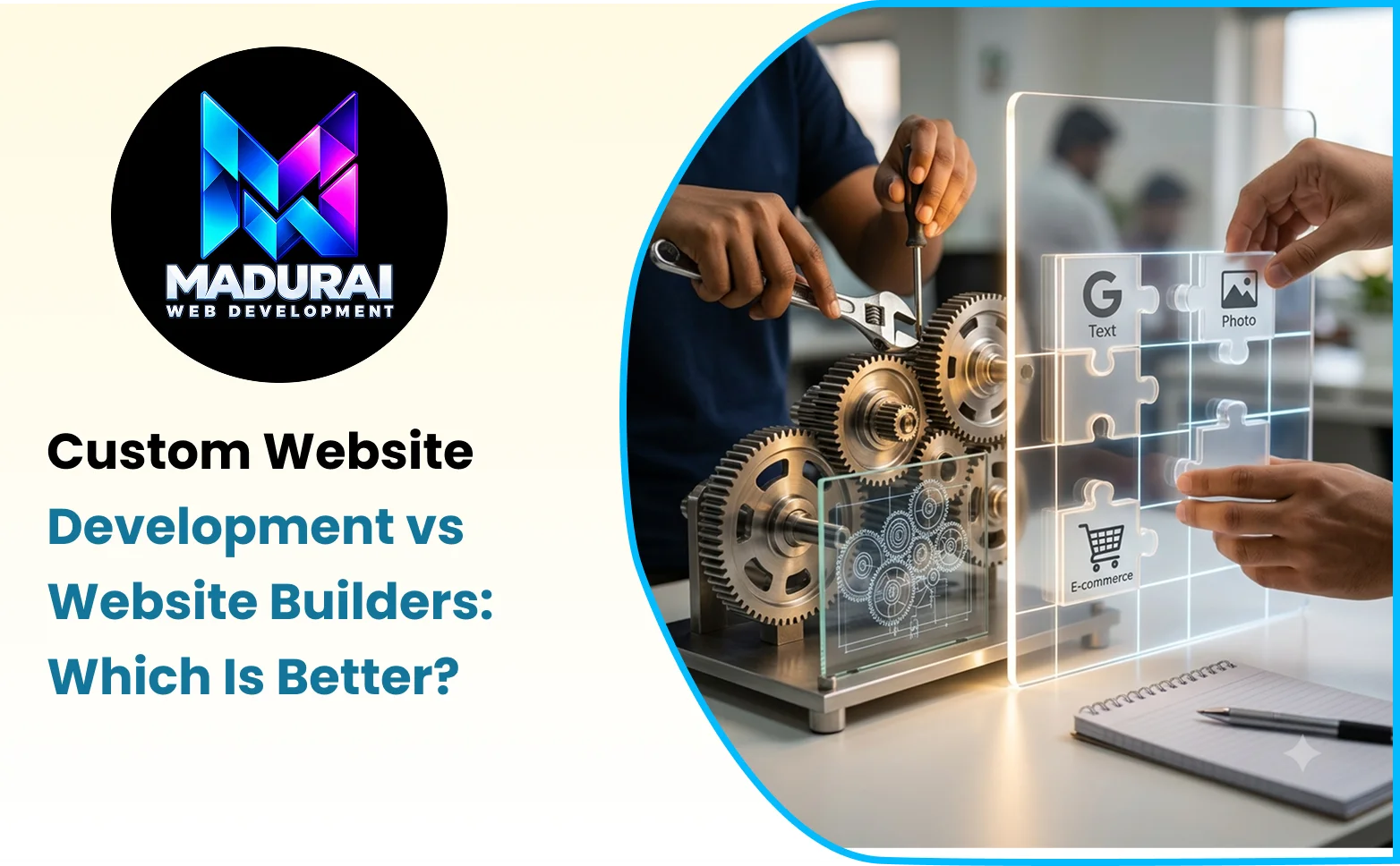
Quick Answer: Should You Choose Custom Development or a Website Builder?
The right choice depends on your business goals, budget, technical requirements, and plans for future growth. Website builders are often suitable for small businesses that need a website quickly with limited technical involvement. Custom website development is generally more appropriate when a business requires specialised functionality, greater control over its architecture, complex integrations, or a tailored user experience. Before choosing either option, evaluate the website's long-term needs rather than focusing only on the initial development cost.
Introduction
Choosing how to build a business website is an important decision that affects more than its appearance. The technology you select influences development costs, design flexibility, website performance, maintenance requirements, search engine optimisation, and the ability to introduce new features as the business grows.
When comparing custom website development vs website builder solutions, businesses often face a choice between convenience and greater control. Website builders provide ready-made templates, visual editing tools, and built-in features that make launching a website easier. Custom development allows developers to create a website around specific business requirements, workflows, and technical needs.
Neither option is automatically the best choice for every business. A local service provider with a few pages may not need a complex custom application, while a business with specialised booking systems, customer dashboards, or advanced integrations may find a website builder restrictive.
This guide explains the differences between custom development and website builders, compares their advantages and limitations, and helps business owners identify the approach that best suits their current needs and future plans.
What Is a Website Builder?
A website builder is a platform that allows users to create and manage websites using ready-made templates, visual editors, prebuilt components, and configurable features. Many builders reduce the need to write code manually, making them accessible to business owners with limited technical experience.
Depending on the platform, users may be able to create service pages, publish blog posts, manage products, accept payments, connect domains, and configure basic SEO settings through a visual interface.
Website builders generally offer a convenient starting point for businesses that want to establish an online presence without managing every technical detail themselves.
How Website Builders Work
Most website builders provide a collection of templates and design components that users can customise. A business might select a suitable layout, replace the sample text and images, configure its colours, and publish the website through the platform.
Additional features may be available through built-in tools, extensions, or third-party integrations. The exact capabilities depend on the platform and subscription plan.
The convenience comes with certain limitations. Businesses may be restricted by the available templates, platform rules, supported integrations, or the degree of control offered over the underlying code and hosting environment.
These limitations may not matter for a straightforward website, but they become more important when requirements become highly specialised.
What Is Custom Website Development?
Custom website development involves designing and building a website around the specific requirements of a business. Developers can create tailored page structures, functionality, integrations, and backend systems instead of relying entirely on a standard website builder's templates and features.
Depending on the project, custom development may use technologies such as HTML, CSS, JavaScript, Laravel, or other frameworks and backend technologies. The appropriate technology depends on the website's purpose, complexity, and maintenance requirements.
A custom website can support a wide range of requirements, from a distinctive corporate website to a complex platform with customer accounts, automated workflows, booking systems, or connections to internal business software.
How Custom Website Development Works
The process typically begins with requirements gathering and website planning. The team identifies business goals, target users, required pages, functionality, design expectations, and technical constraints.
Developers then create the architecture, implement the frontend and backend where required, integrate relevant services, and test the website before launch.
Because the website is built around defined requirements, the business may have greater control over its functionality and implementation. However, custom development also requires careful planning, professional expertise, testing, and ongoing maintenance.
Custom development does not automatically produce a better website. Its value depends on whether the additional control and functionality solve genuine business problems.
Custom Website vs Website Builder: Key Differences
The main difference is the level of control over how the website is designed, implemented, hosted, and maintained.
|
Comparison factor |
Website builder |
Custom website development |
|
Initial setup |
Usually faster with templates and prebuilt features |
Requires planning, design, and development |
|
Initial cost |
Often lower for straightforward websites |
Often higher because of specialised work |
|
Design flexibility |
Depends on templates and platform capabilities |
Can be tailored closely to business requirements |
|
Functionality |
Uses built-in features, extensions, and supported integrations |
Can support specialised features and workflows |
|
Technical control |
Varies by platform and plan |
Depends on the architecture, hosting, and ownership arrangements |
|
Maintenance |
Some infrastructure and updates may be managed by the provider |
Requires an agreed maintenance and update strategy |
|
Scalability |
Suitable within the platform's capabilities and limits |
Can be designed to accommodate specific growth requirements |
|
SEO |
Can support SEO if the platform provides suitable controls |
Offers flexibility over technical implementation, but still requires good SEO practices |
|
Portability |
Moving platforms may require rebuilding or migrating content |
Portability depends on code ownership, architecture, dependencies, and hosting arrangements |
|
Best suited for |
Straightforward websites that need convenient setup |
Websites with specialised requirements or a need for greater technical control |
These differences are general patterns rather than universal rules. Some website builders offer advanced customisation, while some custom projects use established frameworks and components to reduce cost and development time.
Benefits of Website Builders for Small Businesses
Website builders can be a practical choice for businesses that want to launch quickly, control costs, and manage routine updates without depending heavily on developers.
Faster Website Launch
Ready-made templates and prebuilt components reduce the amount of work required to establish a basic website. A business can often prepare its main pages, add contact information, configure its domain, and publish the site without building every component from scratch.
This can be useful when the business needs an online presence quickly and its requirements are relatively straightforward.
Lower Initial Investment
Website builders often offer subscription plans that include hosting and selected website management features. For a small website with limited functionality, this may cost less initially than commissioning a custom project.
However, businesses should consider the total cost over time, including subscriptions, premium templates, paid extensions, transaction fees where applicable, and any specialist development required.
Convenient Content Management
Many website builders provide visual editors that allow business owners to update text, images, service descriptions, and blog posts through a dashboard.
This can reduce the need for developer assistance with everyday content changes. The ease of management depends on the platform and how the website has been configured.
Built-In Features and Support
Some platforms include forms, analytics integrations, basic SEO settings, security features, and ecommerce functionality. Using these built-in tools can simplify setup and reduce the need to assemble every component separately.
Nevertheless, businesses should verify that the required features are actually supported and that the platform provides adequate control over important settings.
Benefits of Custom Website Development
Custom development is valuable when a business needs greater control over functionality, architecture, design, or integration with its existing operations.
Greater Design and Functional Flexibility
One of the main benefits of custom website development is the ability to create page layouts and interactions around specific business requirements.
Instead of adjusting every requirement to fit an existing template, the development team can design the experience around the target audience and intended user journey.
For example, a service business may require a specialised quotation system, while a distributor may need customer-specific pricing and account access. Custom development can provide a suitable foundation for these workflows when they cannot be implemented effectively with an existing platform.
Tailored Business Integrations
Businesses sometimes need their websites to exchange information with CRM systems, inventory software, accounting platforms, booking tools, or internal databases.
Custom development can provide more control over how these systems interact, subject to the capabilities and restrictions of the external services involved.
This can reduce manual work and help connect the website with wider business operations. However, integrations require careful planning, testing, and ongoing maintenance.
Greater Control Over Technical Architecture
A custom project allows the team to select an architecture suited to the website's requirements. This can include decisions about frontend frameworks, backend technology, database design, hosting, caching, and access controls.
The benefit is not simply the ability to use a particular technology. It is the opportunity to select an implementation that meets the project's actual needs.
A well-designed architecture can make future changes easier, but poorly planned custom development can create technical debt and increase maintenance costs.
Support for Specialised Growth
A business may eventually need customer dashboards, multi-step workflows, advanced search, role-based permissions, or other features that exceed the capabilities of its initial website.
Custom development can provide a path to implementing these requirements within a coherent architecture. The system should still be designed carefully because greater flexibility does not guarantee unlimited scalability or low operating costs.
Website Builder vs Custom Development: Comparing the Costs
Cost is often one of the first factors businesses consider, but comparing only the initial price can lead to an incomplete decision.
A website builder may have a lower initial cost because the platform already provides templates, hosting options, and common features. However, recurring subscriptions, premium functionality, extensions, transaction fees, and platform limitations may increase the total expense over time.
Custom development typically requires a larger initial investment because the work may include discovery, design, frontend development, backend functionality, testing, integrations, and deployment. The total cost depends on the project's complexity and the experience of the development team.
Custom websites also require ongoing costs for hosting, updates, backups, security, monitoring, and technical support. These responsibilities should be included in the original budget.
A useful comparison is the total cost of ownership over a defined period. This includes initial development or setup, recurring platform charges, maintenance, integrations, expected improvements, and the cost of changing platforms if necessary.
For example, a five-page business website with a contact form may be economical to build with a website builder. A platform with custom customer workflows and multiple integrations may justify a higher initial investment if those features create meaningful operational value.
The right decision is the option that meets the business requirements at an acceptable total cost, not necessarily the one with the lowest starting price.
Which Option Is Better for SEO?
Both custom websites and website builders can support effective search engine optimisation. Search performance depends on content quality, relevance, crawlability, technical configuration, website structure, user experience, and other factors.
SEO Capabilities of Website Builders
Many website builders support important SEO features such as editable page titles, meta descriptions, image alt text, custom URLs, redirects, and XML sitemaps. Some also provide structured data options and performance optimisation tools.
These features can be sufficient for many small business websites. Before choosing a platform, confirm that it supports the SEO controls needed for the website's planned structure and content strategy.
SEO Capabilities of Custom Websites
Custom development can provide greater control over technical SEO, including URL routing, canonical configuration, structured data, page templates, internal linking, and server-side behaviour.
This flexibility can be useful for complex websites, but it also creates responsibility. Incorrect canonical tags, inaccessible pages, broken redirects, or poorly configured rendering can harm search visibility regardless of how the website was built.
What Businesses Should Prioritise
The most important consideration is whether the selected approach supports a technically sound website with useful content and a clear structure.
Before making a decision, check page speed, mobile usability, metadata controls, crawlability, redirect management, internal linking, structured data requirements, and the ability to update content efficiently.
Neither custom development nor a website builder guarantees better Google rankings. Both require a deliberate SEO strategy and ongoing monitoring.
Performance, Security, and Maintenance Considerations
Performance, security, and maintenance should be evaluated before selecting a platform because they affect both customer experience and long-term operating costs.
Website Performance
Website builders may include hosting and optimisation features, although performance varies by provider, plan, template, and the number of scripts or extensions used.
Custom websites can be optimised around their specific requirements, but performance depends on the quality of the implementation, hosting environment, caching, database queries, images, and third-party services.
Google's recommended good Core Web Vitals thresholds are an LCP of 2.5 seconds or less, an INP of 200 milliseconds or less, and a CLS score of 0.1 or less, measured at the 75th percentile of page visits. These metrics provide useful benchmarks for evaluating loading, responsiveness, and visual stability.
Security Responsibilities
Website builders may manage parts of the underlying infrastructure and software maintenance. However, businesses still need to protect account access, review permissions, configure available security controls, and manage their own content and integrations responsibly.
With custom development, security responsibilities depend on the hosting arrangement and project scope. The business and development team should establish who handles updates, dependency management, backups, monitoring, access control, and incident response.
Custom code needs appropriate review and maintenance rather than being assumed secure simply because it was built specifically for the business.
Ongoing Maintenance
Website builders can simplify routine updates through a central dashboard and provider-managed services. Their limitations may become more apparent when the business needs functionality that the platform does not support.
Custom websites provide more implementation flexibility but require an ongoing maintenance plan. This should include content updates, technical monitoring, security fixes, backups, and testing after significant changes.
The best option is one that the business can maintain reliably with the people, budget, and technical support available to it.
Choosing a Website Platform for Business: What Should You Consider?
The process of choosing a website platform for business should begin with requirements rather than platform popularity.
Business Goals and Website Complexity
If the primary objective is to present company information, explain services, publish articles, and receive enquiries, a website builder may be sufficient.
If the website needs specialised workflows, complex integrations, unique data structures, or custom business logic, custom development may provide a better fit.
Consider both current requirements and realistic future needs. Avoid paying for complex functionality that has no clear business purpose, but do not ignore essential requirements simply to reduce the initial cost.
Internal Skills and Available Support
Think about who will manage the website after launch. If your team needs to update pages frequently without technical assistance, a user-friendly content management interface may be a priority.
If your website requires technical changes regularly, ensure that suitable development support is available. Custom development may be appropriate when that support is planned and funded.
Ownership and Portability
Review the terms governing domain ownership, content access, code ownership, data exports, and hosting control.
With a website builder, some components may be tied to the platform, which can make migration more difficult. Custom development may offer greater portability, but this depends on the codebase, dependencies, licences, hosting configuration, and contractual arrangements.
Businesses should understand these conditions before committing to either option.
Long-Term Flexibility
Consider how the website may change as the business grows. New services, additional locations, ecommerce features, integrations, or customer accounts may require different technical capabilities.
Choose a platform that can support realistic future needs without introducing unnecessary complexity today.
Real-World Examples: Which Approach Fits Different Businesses?
Example 1: A Local Service Business
A local cleaning company or consultancy needs a homepage, service pages, business information, a contact form, and a blog. The business has a limited budget and wants to update content independently.
A website builder may be a suitable choice if its templates, SEO controls, and functionality meet the requirements. Custom development may be unnecessary unless the business needs specialised booking, quotation, or operational features.
Example 2: A Growing Ecommerce Business
A business selling a standard product range needs product listings, a cart, checkout, payment processing, inventory management, and order notifications.
An established ecommerce platform may provide these features more efficiently than building everything from scratch. Custom development becomes more relevant if the business needs unusual pricing logic, complex integrations, or a specialised purchasing experience that the platform cannot support effectively.
Example 3: A Business With Custom Operational Workflows
A company needs a customer portal, role-based access, custom reports, approval workflows, and integration with internal business software.
A website builder may not support all the required functionality without substantial workarounds. Custom development may offer a more suitable architecture because the system can be designed around the business processes.
These examples illustrate why the decision should be based on actual requirements rather than a universal rule that one approach is always better.
Common Mistakes When Choosing Between Custom Development and Website Builders
One common mistake is selecting a platform before documenting the website requirements. This can lead to a mismatch between the chosen technology and the features the business eventually needs.
Another is comparing only the initial cost. Subscription fees, integrations, maintenance, future enhancements, and migration expenses can all influence the total cost of ownership.
Businesses may also underestimate the importance of content management, SEO control, security, and portability. A website that is easy to launch may become difficult to manage if its limitations are not understood beforehand.
Finally, custom development should not be selected simply because it sounds more professional. A custom solution that is unnecessarily complex can cost more to build and maintain without producing meaningful business benefits.
The better approach is to identify essential requirements, compare suitable options, evaluate long-term costs, and choose the solution that meets the business's needs with the least unnecessary complexity.
Conclusion
The comparison between custom website development and website builders is ultimately a decision about requirements, flexibility, cost, and long-term management.
Website builders can be an effective option for businesses that need a straightforward website with convenient setup and familiar management tools. Custom website development can be more suitable when specialised functionality, tailored integrations, or greater architectural control are essential.
Before deciding, document the website's purpose, required features, SEO needs, budget, maintenance arrangements, and future plans. Evaluate the total cost of ownership and confirm that the chosen solution can support the customer experience your business needs.
For businesses exploring website design and development options, Madurai Web Development can be considered when assessing suitable requirements and implementation approaches. The priority should be to choose a solution that supports business objectives, remains manageable over time, and provides a reliable experience for customers.