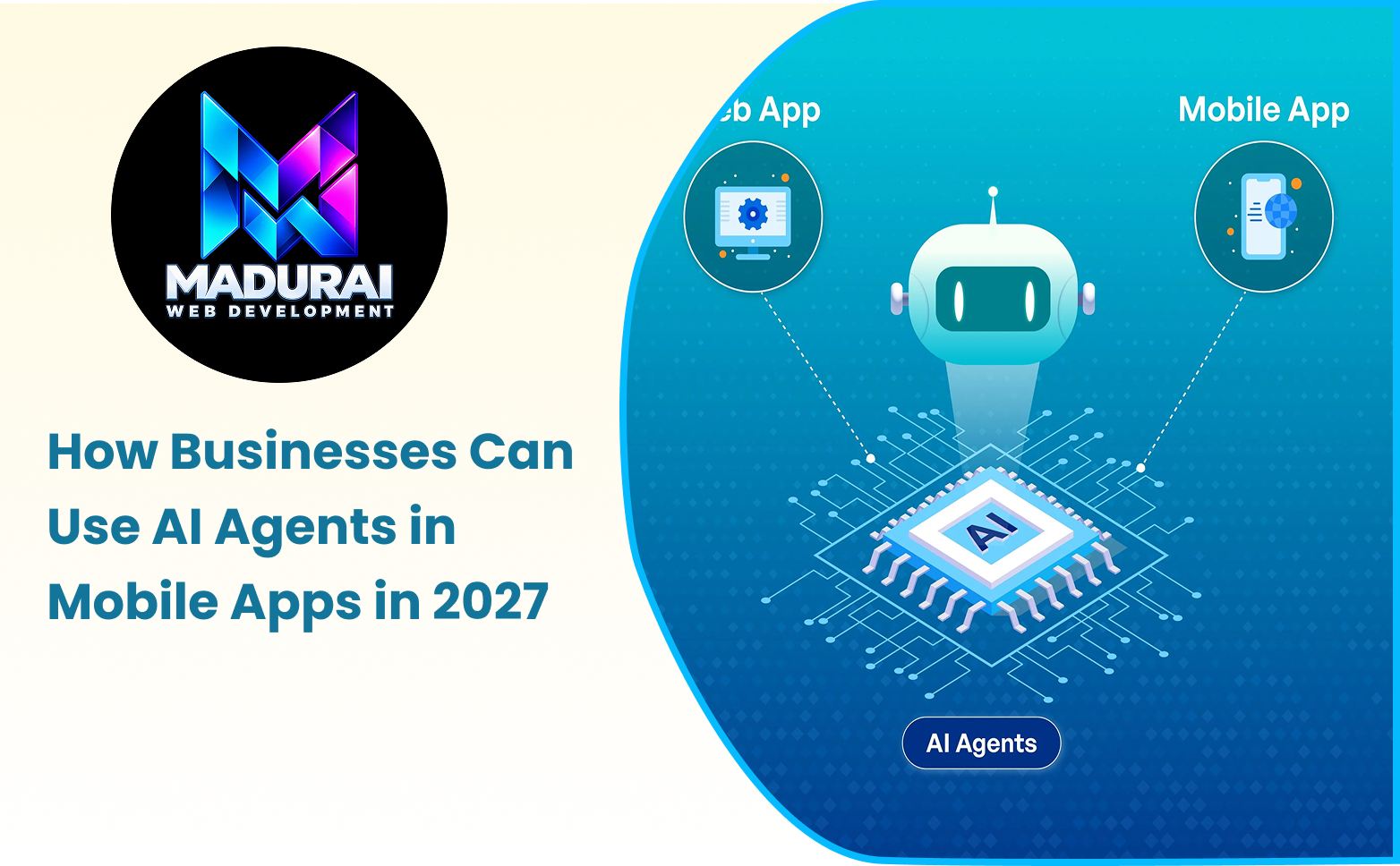
Mobile applications are becoming more intelligent as businesses look for better ways to serve customers, automate daily operations and improve digital experiences. Traditional mobile apps mainly depend on predefined features, menus and user actions. However, AI-powered mobile applications are introducing a more flexible approach by understanding user requests, analysing information and helping complete tasks.
AI Agents in Mobile Apps are becoming an important development opportunity for businesses in 2027. Instead of simply responding to individual commands, AI agents can understand user goals, process information, interact with connected services and perform specific tasks within an application.
For example, a customer using a shopping application could ask an AI agent to find products based on their budget, compare available options and track an existing order. Similarly, a banking application could use an AI agent to explain transactions, answer account-related questions and guide customers through supported banking activities.
For businesses planning their next mobile application, understanding how AI agents work and where they provide practical value can help make better technology decisions.
This guide explains how businesses can use AI agents in mobile apps, the most useful applications, their benefits, development considerations and the steps involved in integrating them into existing or new mobile applications.
1. What Are AI Agents in Mobile Apps?
AI agents are software systems that use artificial intelligence to understand requests, make decisions within defined boundaries and perform tasks to achieve specific objectives.
Unlike traditional application features that follow fixed instructions, AI agents can interpret user intent and determine the appropriate next action based on available information and permissions.
For example, consider a travel booking application. A traditional search feature requires users to enter a destination, travel date and other details manually. An AI agent could understand a request such as:
"I need a taxi from Trichy to Madurai tomorrow morning for four passengers."
The agent can identify the destination, travel date, passenger count and requested service. It can then retrieve relevant options from connected booking systems and guide the user through the reservation process.
How Do AI Agents Work?
AI agents generally operate through a combination of several technologies:
- Large Language Models (LLMs): Understand natural language requests and generate relevant responses.
- Natural Language Processing (NLP): Help applications interpret user messages and identify their intentions.
- APIs and Integrations: Connect AI agents with application features, databases and external services.
- Memory and Context: Maintain relevant information from conversations when appropriate.
- Decision-Making Logic: Determine which actions are suitable for a particular request.
- Tools and Automation: Allow agents to retrieve information or perform approved tasks.
These components work together to help an AI agent understand a request, identify the required information and complete supported actions.
2. Why Should Businesses Use AI Agents in Mobile Apps in 2027?
Customer expectations are changing. Users increasingly expect applications to provide quick answers, personalised recommendations and convenient ways to complete everyday activities.
Traditional mobile applications can provide these features through predefined workflows. However, AI agents introduce another approach by allowing users to interact with application services through natural conversations.
Businesses can consider AI agents for several reasons.
2.1 Improve Customer Support
AI agents can handle frequently asked questions, provide product information, explain service processes and guide users through common problems.
For example, an e-commerce application can use an AI agent to answer questions about delivery status, return policies and product availability.
2.2 Provide Personalised Experiences
AI agents can use relevant customer preferences and permitted application data to provide more suitable recommendations.
A fitness application, for instance, could suggest workout activities based on a user's selected goals, available time and recorded activity.
2.3 Automate Repetitive Tasks
Businesses can use AI agents to reduce repetitive manual activities.
Depending on the integrations and permissions available, an agent may help schedule appointments, organise service requests, retrieve information and update supported records.
2.4 Make Applications Easier to Use
Instead of navigating multiple menus, users can explain what they want through a conversational interface.
This can make complex application workflows easier to understand, particularly for users who are unfamiliar with certain features.
2.5 Support Business Operations
AI agents can also assist employees and internal teams by retrieving business information, preparing reports, organising requests and supporting routine workflows.
The actual level of automation depends on the application's architecture, connected systems and approval requirements.
3. Top Ways Businesses Can Use AI Agents in Mobile Apps
AI agents can support different business requirements depending on the industry, application features and customer expectations.
Here are some practical AI agent use cases that businesses can consider in 2027.
3.1 AI Agents in E-Commerce Mobile Applications
Online shopping applications can use AI agents to improve product discovery and customer assistance.
Rather than searching through multiple categories, customers can describe what they need.
For example:
"I need a laptop for software development under ₹60,000."
The AI agent can understand the budget and intended use, retrieve matching products and explain the differences between available options.
Possible features include:
- Conversational product search.
- Personalised product recommendations.
- Product comparison assistance.
- Order tracking.
- Shopping cart assistance.
- Return and refund guidance.
- Customer support automation.
These features can help customers find relevant products and navigate the shopping process more conveniently.
3.2 AI Agents in Healthcare Mobile Applications
Healthcare applications can use AI agents to simplify administrative and patient-support activities.
For example, a patient could ask an application to find available appointment slots or explain how to access their medical reports.
Possible features include:
- Appointment scheduling assistance.
- Hospital service information.
- Medical report navigation.
- Medication reminder management.
- Patient registration guidance.
- Healthcare service enquiries.
Healthcare AI agents must follow strict privacy and security requirements. They should not replace qualified medical professionals or independently make diagnoses and treatment decisions.
3.3 AI Agents in Banking and Finance Applications
Financial applications can use AI agents to make account-related information easier to understand.
For example, a customer might ask:
"Show my transactions from the previous month and explain the recurring payments."
With appropriate account access and permissions, an AI agent can retrieve relevant transaction information and provide a summary.
Possible features include:
- Transaction search.
- Spending summaries.
- Payment reminders.
- Financial information assistance.
- Account service guidance.
- Fraud reporting assistance.
Sensitive financial actions should require appropriate authentication, confirmation and security controls.
3.4 AI Agents in Travel and Booking Applications
Travel businesses can use AI agents to simplify trip planning, reservations and customer communication.
For example, users could describe their travel requirements in a single message instead of navigating several booking screens.
Possible features include:
- Destination recommendations.
- Hotel and transportation search.
- Travel itinerary planning.
- Booking assistance.
- Reservation status updates.
- Travel information support.
- Customer enquiry management.
An integrated travel application could connect AI agents with taxi booking systems, hotel services and travel databases to provide relevant options.
3.5 AI Agents in Education Mobile Applications
Educational applications can use AI agents to support students, teachers and training institutions.
Students could ask questions about course topics, request explanations or find relevant learning resources.
Possible features include:
- Personalised learning assistance.
- Course recommendations.
- Study schedule organisation.
- Practice question generation.
- Learning resource discovery.
- Student enquiry management.
- Assignment guidance.
Educational AI agents should support learning rather than simply provide answers without helping students understand the subject.
3.6 AI Agents in Real Estate Applications
Real estate businesses can use AI agents to make property discovery and customer communication easier.
A user could enter a request such as:
"Find two-bedroom apartments in Trichy within my budget."
The agent can interpret the requirements and retrieve matching listings from connected property databases.
Possible features include:
- Property search assistance.
- Budget-based recommendations.
- Property comparison.
- Location-based property discovery.
- Site visit scheduling.
- Customer enquiry management.
3.7 AI Agents in Food Delivery Applications
Food delivery platforms can use AI agents to simplify restaurant discovery and order-related support.
Possible features include:
- Restaurant recommendations.
- Menu search.
- Dietary preference filtering.
- Order status assistance.
- Delivery information.
- Customer support.
For example, a user could ask for vegetarian restaurants that deliver to their location. The AI agent can retrieve matching options from the platform's available restaurant data.
4. Important Features to Build in AI-Powered Mobile Apps
Businesses planning AI-powered mobile apps should identify features that solve genuine customer problems rather than adding AI simply because it is a growing technology.
The following features can provide practical value.
Conversational AI Assistant
A conversational assistant allows users to interact with an application using natural language instead of relying entirely on traditional navigation.
Personalised Recommendations
AI agents can analyse permitted user preferences, previous interactions and relevant application information to suggest suitable products, services or content.
Intelligent Search
Traditional search often depends on exact keywords. AI-powered search can interpret the meaning behind a user's request and retrieve more relevant results.
Task Automation
AI agents can help users complete supported activities such as scheduling appointments, submitting enquiries and retrieving information.
Real-Time Information Retrieval
By connecting with application APIs and approved data sources, AI agents can retrieve updated information such as order status, appointment availability and booking details.
Multilingual Communication
Businesses serving customers who speak different languages can consider multilingual AI assistants to make application interactions more accessible.
Human Support Handover
AI agents should recognise when a request requires human assistance and provide a smooth transfer to the appropriate support team.
5. How AI Agent Integration Works in Mobile Apps
Integrating AI agents into mobile applications requires more than connecting an AI model to a chat interface.
The application needs a secure architecture that connects the user interface, AI services, business logic and relevant data sources.
A typical AI agent integration workflow includes the following components.
Step 1: Mobile Application Interface
The user interacts with the AI agent through a chat window, voice interface or another application feature.
Step 2: AI Model Integration
The application sends the user's request to an AI service through a secure backend connection.
Step 3: Intent Understanding
The AI model interprets the request and identifies the information or action required.
Step 4: Tool and API Integration
If the request requires external information or an application action, the agent can use approved APIs or tools.
For example, a booking application may connect its AI agent to:
- Customer information systems.
- Booking databases.
- Payment services.
- Notification systems.
- Availability management APIs.
Step 5: Action Validation
The backend verifies user permissions, business rules and required confirmations before allowing an action to proceed.
Step 6: Response Generation
The AI agent receives the relevant result and presents it to the user in a clear and understandable format.
This architecture allows businesses to introduce AI capabilities without replacing every existing application feature.
6. Technologies Used for AI Agent Development in Mobile Apps
Choosing the right technology depends on the application's requirements, expected traffic, security needs and development budget.
Some commonly considered technologies include:
| Technology | Purpose |
|---|---|
| Flutter | Cross-platform mobile application development |
| React Native | Android and iOS application development |
| Kotlin | Native Android development |
| Swift | Native iOS development |
| Python | AI services and backend development |
| Node.js | Backend APIs and application integration |
| OpenAI API | AI model integration |
| Anthropic Claude API | AI assistant and agent integration |
| Firebase | Authentication, notifications and application services |
| PostgreSQL | Structured application data storage |
Businesses should select technologies based on their existing systems and technical requirements rather than choosing a framework simply because it is popular.
7. What Is MCP and How Can It Help AI Agents in Mobile Apps?
Model Context Protocol (MCP) is an open protocol that provides a standardised way for AI applications to connect with external tools and data sources.
For businesses developing AI agents, MCP can help organise how an AI system accesses supported services.
For example, a mobile application may have an AI assistant that needs information from a booking system, customer database and inventory platform.
An MCP server can expose approved tools and resources that an AI client can use to interact with those systems.
Example MCP integrations for mobile applications:
- Product information retrieval.
- Customer support data access.
- Booking system integration.
- Inventory information.
- Internal business knowledge.
- Task and workflow management.
MCP does not automatically turn a mobile application into an AI agent. It provides an integration protocol that can help AI systems interact with external capabilities.
Businesses should also implement authentication, access controls, input validation and approval mechanisms when connecting sensitive systems.
8. Benefits of AI Agents for Business Automation
AI agents can create value beyond customer-facing chat features. They can also support internal business processes and improve operational efficiency.
Some important benefits include:
- Reduced repetitive work: AI agents can assist with routine information retrieval, enquiry handling and workflow activities.
- Improved customer experience: Users can communicate their requirements naturally and receive relevant assistance.
- Faster information access: Agents can retrieve information from connected systems without requiring users to search multiple sections manually.
- Personalised interactions: Relevant application data can help agents provide more suitable recommendations.
- Better employee support: Internal agents can help employees locate company information, organise tasks and access approved business tools.
- Flexible application experiences: Businesses can introduce new AI-supported workflows as their requirements change.
However, these benefits depend on implementation quality, data accuracy, integration reliability and the suitability of the selected tasks.
9. Challenges Businesses Should Consider Before Building AI Agents
Although AI agents offer several opportunities, businesses should understand their limitations before introducing them into mobile applications.
Data Privacy and Security
AI agents may interact with personal, financial or business information. Applications must protect sensitive data through appropriate access controls, encryption and secure data handling.
Incorrect AI Responses
AI models can generate inaccurate or misleading responses. Businesses should use reliable data sources, validation processes and clear limitations for important operations.
Integration Complexity
Connecting an AI agent with existing databases, APIs and third-party platforms can require additional development and testing.
Development and Maintenance Costs
AI model usage, infrastructure, integrations, monitoring and ongoing improvements contribute to the total cost of ownership.
Performance and Response Time
AI-powered features should provide an acceptable user experience. Businesses need to consider network availability, model response times and fallback options.
Human Oversight
Not every activity should be completed automatically. Sensitive payments, account changes, medical decisions and other important actions may require human review or explicit user confirmation.
10. How to Build AI Agents for Your Business Mobile App
Businesses interested in AI agent development should begin with a clear application requirement instead of immediately selecting an AI model.
A practical development process includes the following steps.
Step 1: Identify Business Requirements
Determine which customer problems or internal activities the AI agent should address.
Step 2: Select Suitable Use Cases
Start with specific tasks such as customer support, product discovery, appointment scheduling or order tracking.
Step 3: Choose the AI Technology
Evaluate suitable AI models, backend frameworks, databases and integration technologies.
Step 4: Design the Application Architecture
Plan how the mobile interface, AI model, backend services, APIs and databases will communicate.
Step 5: Develop and Integrate the AI Agent
Build the agent with clearly defined tools, permissions and business rules.
Step 6: Test Real-World Scenarios
Test different user requests, incorrect inputs, unexpected responses, API failures and security conditions.
Step 7: Deploy and Monitor
Release the feature gradually and monitor response quality, user feedback, operating costs and task completion rates.
Step 8: Improve Based on User Behaviour
Use appropriate performance data and customer feedback to improve the agent's capabilities over time.
11. What Should Businesses Build First in 2027?
Not every business needs a fully autonomous AI agent. The right starting point depends on customer expectations, application complexity and available business data.
Here are some practical starting points.
| Business Type | Recommended AI Agent |
|---|---|
| E-commerce | Product discovery and shopping assistant |
| Healthcare | Appointment and patient support assistant |
| Banking | Transaction information assistant |
| Education | Personalised learning assistant |
| Travel | Trip planning and booking assistant |
| Real Estate | Property search assistant |
| Food Delivery | Restaurant and order assistance |
| Enterprise | Internal business workflow assistant |
For most businesses, a focused AI agent that completes one clearly defined task reliably is a better starting point than an agent with unrestricted access to multiple systems.
12. Future of AI Agents in Mobile App Development
AI agents are expected to influence how businesses plan and develop mobile applications in the coming years.
Instead of treating AI as a separate chatbot feature, developers can integrate intelligent assistance into existing application workflows.
Some areas businesses should watch include:
- Voice-based AI interactions: Users may increasingly interact with applications through natural voice commands.
- Multimodal AI: Applications can combine text, images, audio and other information to understand user requirements.
- Personalised AI experiences: Agents can provide assistance based on relevant user preferences and permitted application context.
- Multi-agent workflows: Different specialised agents may work together to complete complex business processes.
- AI-powered enterprise applications: Businesses can connect agents with internal systems to support employee productivity.
- Context-aware mobile experiences: Applications can provide more relevant assistance based on the user's current task and available information.
The most successful implementations will focus on usefulness, security, reliability and measurable business outcomes rather than simply adding more AI features.
Conclusion
AI agents are creating new possibilities for businesses that want to make their mobile applications more intelligent, convenient and useful. From e-commerce and healthcare to banking, education and travel, businesses can introduce AI-powered features that simplify customer interactions and support everyday operations.
In 2027, the focus should not simply be on adding an AI chatbot to a mobile application. Businesses should identify meaningful tasks, connect AI agents with reliable systems and establish appropriate security and approval mechanisms.
Whether developing a new mobile application or upgrading an existing platform, starting with a focused AI agent can help businesses understand its practical value before expanding into more advanced workflows.
The future of mobile app development will be shaped not only by how applications look and function, but also by how effectively they understand user needs and help people complete tasks.